
Cyber Defense on the Front Line: The French Army Facing New Threats




Created on January 1, 2025 in Rennes, the cyber defense regiment is a new unit dedicated to cyberspace within the French Army. Its mission is to protect and secure the “digital surface” of land forces. Ultimately, it will consist of around 400 specialists. The regiment can deploy specialized teams within 24–48 hours to counter digital attacks against allied units deployed in conflict zones. To carry out its missions, the regiment has advanced technological tools. It uses cybersecurity systems comparable to those of the best civilian organizations, adapted to the military context: intrusion detection and prevention equipment, malware analysis tools, threat intelligence platforms, strengthened encryption, etc. “Our resources make it possible to deploy in a very short time – sometimes in less than 24 hours – full capabilities for analysis, detection, monitoring and incident response on an operational theater,” emphasizes Lieutenant Colonel Jean-François Caverne. The objective is to ensure a level of protection equivalent to that provided in mainland territory, even in a war zone.
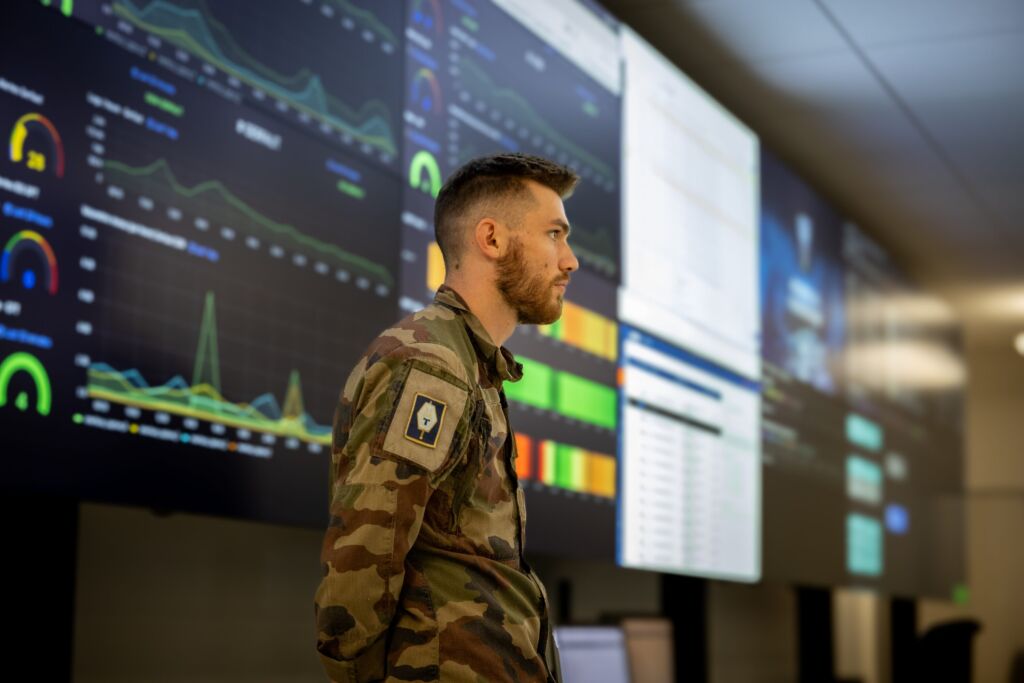
The regiment also incorporates emerging technologies such as artificial intelligence and machine learning. As the commanding officer points out, “the regiment is constantly innovating” and “integrates emerging technologies such as artificial intelligence” in order to maintain an advantage over the adversary. This approach relies in particular on regular cyber defense exercises such as DEFNET or Cyber Coalition, which enable units to train against simulated attacks in complex operational environments. These exercises aim to test the teams’ detection, coordination and response capabilities, both from fixed centers and in the field. As a result, the regiment is also developing deployment capabilities adapted to operational constraints. Specialized teams can be deployed rapidly to support engaged forces, install monitoring systems and strengthen the security of networks on bases, command posts or camps. Once on site, they connect to existing infrastructures and contribute to restoring or maintaining digital systems. This rapid deployment capability constitutes a central element of cyber support to external operations and joint engagements.
Strategic and Joint Integration
The regiment is fully integrated into the national cyber defense strategy led by COMCYBER. “It directly contributes to the orientations defined by COMCYBER and by the French Army,” specifies Lieutenant Colonel Jean-François Caverne. In constant coordination with COMCYBER, the regiment operates within an organization designed to ensure coherence between actions carried out in the field and the strategy defined at the national level. COMCYBER notably organizes joint exercises such as ORION, in which the regiment’s units participate.
Within the French Army, the regiment falls under the Command for Digital and Cyber Land Support (CATNC), which oversees the Digital and Cyber Support Brigade (BANC) and ensures the integration of cyber defense into land operations. During major exercises such as DEFNET 2024, the regiment worked with the Air Force and the Navy to secure shared systems and infrastructures, particularly in the fields of air and naval defense. This cooperation relies on constant exchanges between the armed forces, each of which has its own cyber units but shares information and alert procedures.
At the international level, France is highly involved within NATO (Cyber Coalition) and the European Union (Cyber Rapid Response Teams). The regiment sends observers or contributors to these coalitions and participates in joint exercises. Exchanges of information and doctrines with allies such as the United States or the United Kingdom make it possible to adapt to adversaries’ tactics and to train cyber forces in a global context where threats are multiplying. In addition, “the international cyber community and joint exercises make it possible to anticipate new threats, better understand adversaries’ methods of action and strengthen interoperability during joint or multinational engagements,” adds the regiment’s commanding officer.
Cyber Threats and Vulnerabilities
Attacks against land forces have become more varied and aggressive: intelligence espionage, sabotage of sensors, influence harassment. As the cyber regiment’s commanding officer explains, “cyberattacks, protean by nature, can arise without the slightest warning sign and spread within seconds.” Current conflicts show that the adversary combines traditional military action with digital operations (cyberattacks against infrastructures, disinformation campaigns, etc.). This logic of hybrid warfare requires the regiment to remain constantly on alert, “because the adversary never sleeps, and neither does cyber defense.”
A central issue concerns the vulnerability of connected weapons systems. The SCORPION program has profoundly modernized land forces by introducing new vehicles such as the Griffon, the Jaguar or the Serval, as well as a shared information system: SICS. According to the Ministry of the Armed Forces, this program relies on “the integration of new armored vehicles and a single information system […] enabling connected collaborative combat.” This networking facilitates the rapid sharing of tactical information between units. It strengthens coordination on the ground but also exposes equipment to new risks. Interconnected sensors, electronic command systems and radio links can constitute potential entry points for an adversary capable of attempting intrusions, jamming or targeted disruptions. “Scorpion armored vehicles emit a fairly significant electromagnetic radiation which, while not traceable or interceptable, is detectable,” explains Léo Péria-Peigné, researcher at the French Institute of International Relations (Ifri).

The most significant incident occurred during the DEFNET exercise in March 2024. A fighter disabled a Griffon in a few seconds using a simple modified rangefinder. The vehicle’s systems were saturated to the point of forcing an emergency shutdown. In an environment where the digitization of the battlefield is progressing rapidly, the challenges facing the cyber defense regiment are numerous. The expansion of the digital surfaces to be defended, the protection of increasingly interconnected weapons systems, growing data flows and networked communications in the field all increase potential points of vulnerability. Added to this is the emergence of non-state or irregular adversaries capable of exploiting low-cost cyber tools. To address this evolution, the regiment will need to continue building its capabilities while consolidating its expertise. As Lieutenant Colonel Jean-François Caverne emphasizes, “being ready, at the right level, in the right place, with the right response” has now become an operational guiding principle.