
“Hormuz Tax” on the global internet: the fictitious toll and the real threat to cables




A few days later, Ebrahim Zolfaghari, spokesperson for the Khatam al-Anbiya military headquarters, repeated the threat on social media: “We will impose fees on internet cables.” MP Mostafa Taheri, a member of Parliament’s Industries Commission, put the potential windfall at $15 billion a year.

Can Iran actually carry out this threat? Specialists in maritime law and telecommunications say no. Such a toll appears unenforceable, both legally and technically. But while the tax looks like geopolitical posturing, Tehran’s ability to disrupt regional internet infrastructure by other means is very real.
Legal and geographical reality of the tax
Iran’s argument rests on a selective reading of the 1982 United Nations Convention on the Law of the Sea (UNCLOS). State media cite Article 34: the right of transit passage through an international strait does not deprive the coastal state of sovereignty over the seabed of its territorial sea. For Tehran, a cable laid without authorization amounts to an occupation of Iran’s seabed. This interpretation ignores the rest of the convention. Article 79 guarantees all states the right to lay and maintain cables on a coastal state’s continental shelf. Article 44 prohibits any obstruction or suspension of transit passage, including in wartime. Tehran signed UNCLOS in 1982 but never ratified it, as did the United States.
By way of comparison, some have pointed to the example of Egypt. Cairo collects several hundred million dollars each year from cables transiting through its territory. In Egypt, most Europe-Asia links use terrestrial sections managed by Telecom Egypt, which sells capacity on its national fiber-optic networks. In other words, this is not a charge for submarine passage, but the operation of land-based networks located inside the country. By contrast, the cables in the Strait of Hormuz all run underwater and, as will be discussed, largely through Omani waters. The Egyptian analogy, often cited in the Iranian press, therefore does not justify a submarine toll regime.
Then there is the question of who would pay. Iran wants to force Google, Meta, Microsoft and Amazon to register under Iranian law, but US sanctions prohibit these groups from transferring even a single dollar to Tehran. The payment mechanism is blocked on the corporate side before it even exists on the Iranian side. On May 1, 2026, OFAC warned that any payment would expose companies to sanctions.
Aware of the instability on the northern shore of the Gulf, cable consortiums have anticipated the Iranian risk for decades. A large share of transit cables, including AAE-1 and SEA-ME-WE 5, were deliberately laid in Omani waters, south of the strait. Iran therefore has no jurisdiction over them. Only two systems pass through Iranian waters: FALCON, operated by Global Cloud Xchange, and Gulf Bridge International (GBI), owned by a company of the same name based in Qatar. These are the two networks most directly exposed to retaliatory measures or physical pressure from Tehran.
A region increasingly dependent on digital infrastructure
Unlike the Bab el-Mandeb Strait in the Red Sea, through which around 17% of global internet traffic and more than 90% of direct communications between Europe and Asia pass, the cables strictly affected by Hormuz account for less than 1% of global international bandwidth. A total outage at Hormuz would therefore not trigger a global blackout, but the regional impact would be significant. Dependence on the strait is not uniform across the region; it depends on where cables make landfall. Qatar, Kuwait, Bahrain and Iraq have limited route diversity and remain locked behind Hormuz. Iraq has only two international cables in service, FALCON and GBI — precisely the two that pass through Iranian waters. A closure would leave the country reliant solely on its terrestrial links. The United Arab Emirates lands most of its systems in Fujairah, on the Gulf of Oman, bypassing the strait. Saudi Arabia derives most of its bandwidth from cables landing on its Red Sea coast. Oman lands its own cables on the Gulf of Oman and the Arabian Sea. None of these three countries depends entirely on submarine connectivity inside the Persian Gulf, and all countries retain terrestrial redundancy.
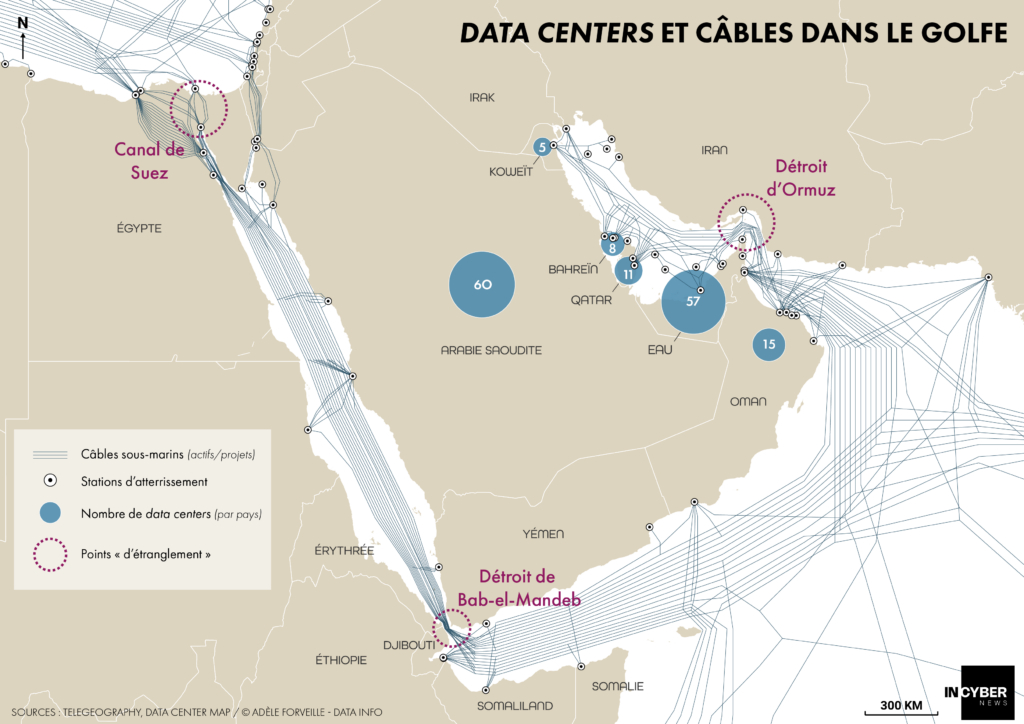
But the issue goes beyond the smooth functioning of consumer connectivity. As part of their economic diversification strategies, the Gulf monarchies have invested billions in data centers and artificial intelligence. According to Data Center Map, Gulf countries have around 156 data centers, led by Saudi Arabia and the UAE. The Gulf data center market is expected to grow from $3.5 billion in 2024 to nearly $9.5 billion by 2030. Abu Dhabi is building Stargate UAE, a one-gigawatt cluster operated by OpenAI and Oracle, built by G42, in which Microsoft has invested $1.5 billion. Qatar has launched Qai, while Saudi Arabia is driving Humain. This digital architecture depends on a continuous cross-border flow of data that only submarine cables can carry.
Hybrid warfare as the underlying threat
The main risk is not so much the tax or spectacular military sabotage, but hybrid warfare below the threshold of open conflict, disguised as a technical incident or a maritime accident. The Red Sea precedent in 2024 showed how fragile these infrastructures are. The cargo ship Rubymar, hit by a Houthi missile, drifted for nearly two weeks while dragging its anchor before sinking. Three major cables were cut nearby — AAE-1, Seacom and EIG — disrupting around 25% of regional traffic, according to HGC Global Communications.
Another means of pressure could lie in blocking maintenance. Cables break frequently, between 150 and 200 times a year worldwide, mostly because of anchors and fishing activity. To carry out repairs, a cable ship must remain stationary for several days at the same point, making it exposed. Maintenance in the Gulf relies on a single Emirati company, e-Marine, and its five vessels. Since Operation Epic Fury, launched in late February 2026, only one of these vessels has been located inside the closed waters of the Gulf, while the others have been held up in the Red Sea or the Indian Ocean. Iran requires any repair work in its zone to be entrusted to national companies approved by the IRGC. By refusing permits or threatening crews, it can allow a link to deteriorate for weeks. A repair normally takes around forty days. In a war zone, it can stretch into months. Beyond the difficulties linked to repairing existing cables, problems in the Red Sea have delayed the deployment of several submarine cable systems, including 2Africa, India Europe Xpress (IEX), Raman, SeaMeWe-6 and Africa-1.
Asymmetric dependence on international connectivity
For more than a decade, Tehran has been investing in its National Information Network (NIN), a domestic internal internet. This parallel network ensures the continuity of many services — administrative, banking and government services — even in the event of a cutoff from the global internet. In practice, Iran has already demonstrated its ability to disconnect; during the 2019 protests and again in January 2026, Iranian authorities ordered massive blackouts of the public network. The most recent, triggered on February 28, 2026, lasted 88 days, until May 26 — the longest shutdown ever imposed by a state.
This decoupling does not exist in the Gulf monarchies. Their growth and stability depend on permanent international connectivity: financial flows, trading platforms, online payments, cloud services for businesses and more. A prolonged disruption of global traffic would therefore weigh far more heavily on their economies than on Iran’s. In such a scenario, the political and economic costs would be distributed unevenly among regional actors.
This ability to endure total isolation shapes the balance of power. A shutdown of data flows at Hormuz would inflict heavy losses on Iran’s Gulf neighbors and on markets, while leaving its own power structures relatively spared. While the tax will most likely never be collected, the threat of asymmetric warfare beneath the surface is real.