Special Report What Future Are the AI Lords Preparing for Us? (5/7)
For Musk, Lord of the Frontier, the Future Belongs to Whoever Holds the Keys
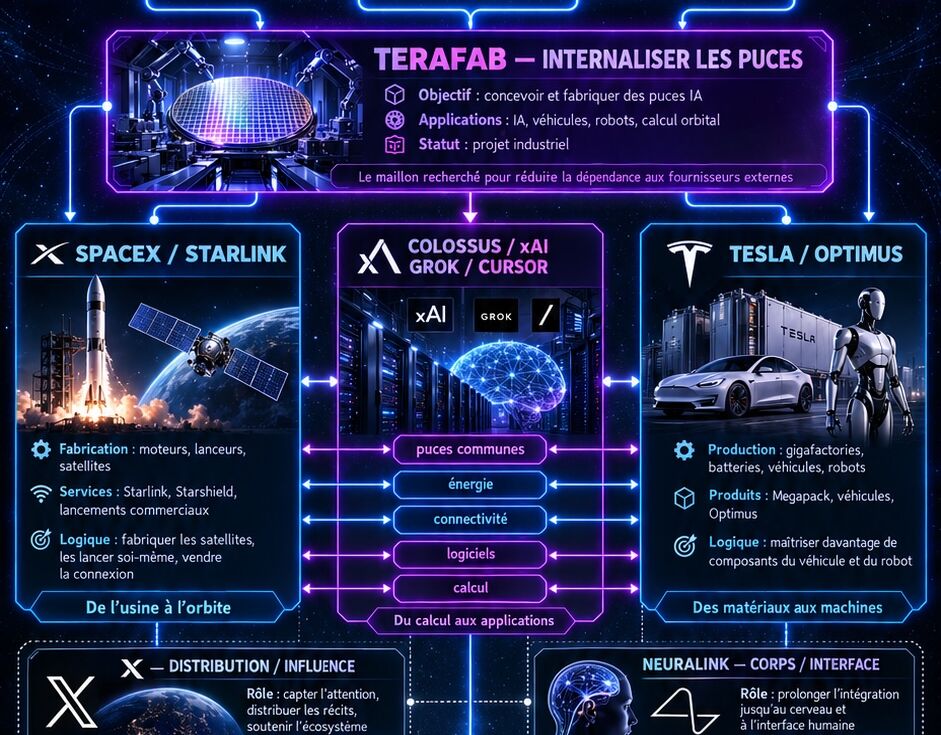
SpaceX has absorbed xAI, then Cursor: rockets, satellites, AI models, supercomputers and software now make up a single empire. Musk raised $75 billion on the stock market without giving up control. He promises Mars and robots for all. But behind this private “Foundation,” who will own the roads to emancipation?
From X to Starlink: privately controlled networks
Elon Musk has just crossed a new frontier. On October 20, SpaceX announced quarterly profits of $4.4 billion, while its AI business now exceeds Starlink in terms of revenue. And the billionaire is already contemplating the next step: merging SpaceX with Tesla. Rockets, satellites, AI models, robots, cars and supercomputers could soon belong to a single empire, all under the control of one man who promises to free humanity from its constraints.
Last June, he had already pulled off an operation worthy of a financial science-fiction novel. SpaceX went public, raising $75 billion, a record for an IPO on the American market. Initial valuation: some $1,770 billion. Enough to fund a respectable collection of Martian dreams. [1]
Elon Musk has not, however, lost control of his empire: the shares issued were Class A, carrying one vote each. His own are Class B, with 10 votes each. At the close of the operation, Musk therefore retained about 82% of the voting rights. Money is welcome so long as he keeps the keys to the ship. [2] In The Coming of Neo-Feudalism, Joel Kotkin described Tech bosses who, “like all aristocracies, often resist any dispersal of their power.” SpaceX offers a clinical demonstration. [3]
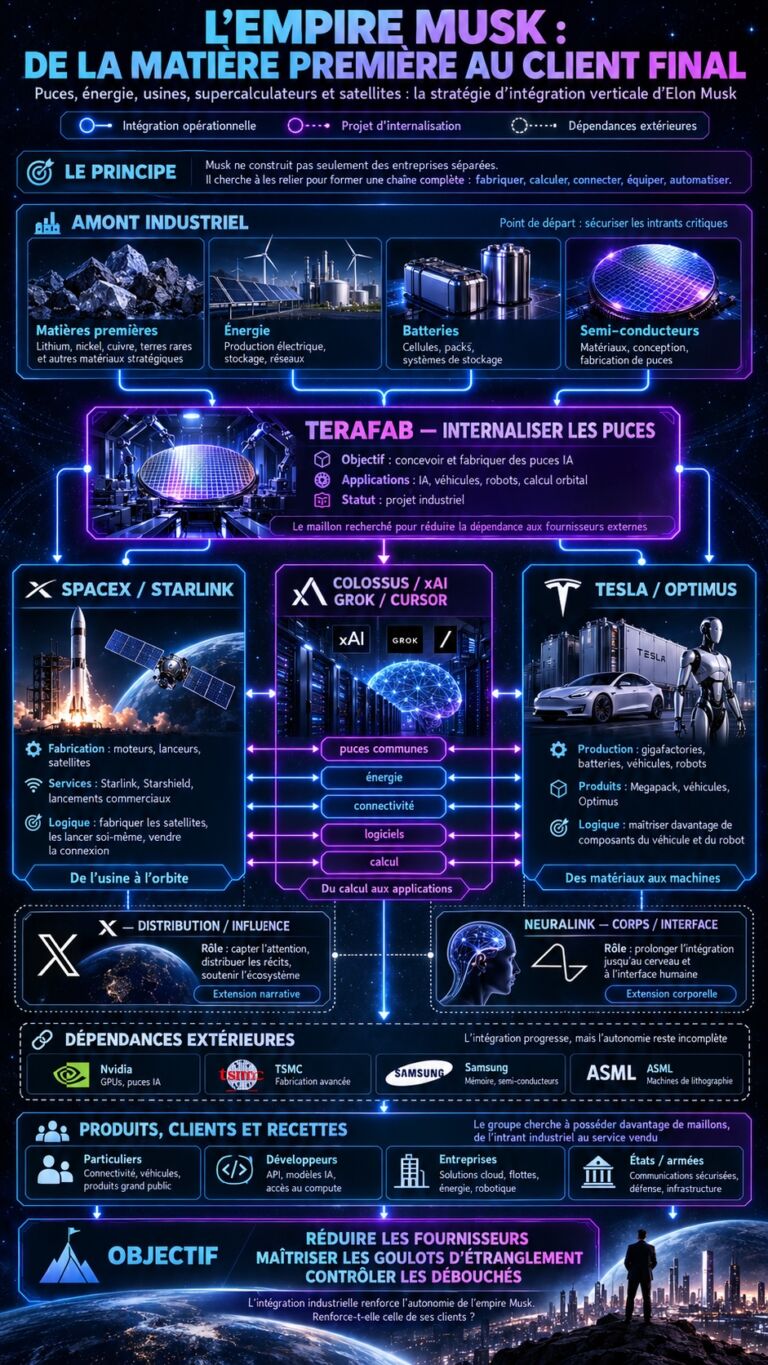
Our special report on the AI lords has already explored the laboratories of OpenAI and Anthropic, everyday professional life under Microsoft, and then Palantir’s sovereign nervous system. Musk is building a different kind of fiefdom: not only services, but the roads that make it possible to communicate, produce, work, fight and, he promises, one day leave Earth. The question remains who will hold the keys.
SpaceX: other people’s money, the founder’s power
The change goes far beyond questions of capital control. The absorption of xAI in February had already brought together rockets, satellites, a social network, AI models and the Colossus data centers. X had previously been folded into xAI’s perimeter. [4] In August, the $60 billion acquisition of Cursor added AI-assisted programming tools to this ensemble. [5] SpaceX can now operate at several levels: designing the models, hosting their execution, and offering the software that puts them to use. [6]
The rest of the Musk group has not been merged into SpaceX. Tesla and Neuralink remain separate companies for the time being. Interdependencies are nonetheless growing: Tesla has invested two billion dollars in SpaceX, supplies it with energy equipment, and recorded $318 million in Megapack battery sales in the second quarter of 2026. [7]
The difference with other AI giants is striking: Musk does not merely buy dominant positions, he built the reusable launcher industry, deployed a satellite constellation and invested massively in electrical and computing facilities. These are real industrial capabilities, with customers and material constraints. That is precisely the whole point: a supplier that delivers infrastructure that is hard to replace holds a more solid power than a mere seller of promises. The fiefdom has no need of walls when its services become indispensable.
Starlink earns the money that AI devours
In the second quarter of 2026, SpaceX recorded revenue of $7.8 billion, but a net loss of $541 million. Its connectivity business, led by Starlink, generated $1.66 billion in operating income. AI posted $1.26 billion in operating losses and nearly $15.8 billion in capital expenditure over the quarter. [8] The contrast sums up the empire’s economics: the satellites earn – a little – while the race for intelligence swallows – a great deal – of capital.
Perhaps to escape this difficult equation, Musk also intends to bill his machines to his competitors. SpaceX has concluded a computing capacity contract with Anthropic providing, once ramped up, $1.25 billion per month, cancellable with ninety days’ notice. [2] Grok’s competitor thus becomes Colossus’s customer. A commercial feat and a remarkable shift in the balance of power.
In our episode on the cognitive fiefdom, we detailed the labs’ dependence on computing forges, so there is no need to take inventory again here. What is new is that an actor claiming to develop its own models is at the same time renting out its computing power to other laboratories.
Kotkin had sensed that “the rush toward artificial intelligence risks reinforcing the dominant position of companies that already possess immense reserves of money and talent.” [3] In Musk’s case, the reserve is also measured in power plants, industrial land, buildings and machines, in a drive for vertical integration that makes his fiefdom singular.
Terafab: Lord Musk’s forge
The Terafab project, unveiled in March 2026, aims precisely to reduce Tesla’s and SpaceX’s dependence on semiconductor manufacturers. Musk wants to produce, in Texas, chips for autonomous vehicles, robots, data centers and, eventually, orbital installations. [9] These are considerable ambitions in the face of Nvidia, TSMC and Samsung, whose industrial chains are not replicated with triumphalist tweets.
An advanced foundry requires lithography equipment, specialized teams, stabilized processes, high yields and long learning curves. In October, a possible TSMC stake was still under study, while Musk wished to retain operational control of the complex. [10] Between ambition and a productive factory, the undertaking is immense.
The same reservation applies to the space data centers dreamed of by the richest man in the world: the Sun supplies energy, but the equipment has to be launched, its heat dissipated by radiation, it must be shielded from radiation, maintained, and the data must be routed back. A technological possibility worth exploring is a long way from being a profitable business.
The strategic direction, however, is hardly in doubt. Where Microsoft organizes access to several models within its professional environment, Musk seeks to own ever more links upstream: electricity, computing, chips, software and connectivity. He has not yet escaped his suppliers, but he is working to make that dependence less decisive.
Mars and Starbase: when the science-fiction novel becomes a financial target
This profusion of investment does not obey a purely commercial logic. Musk keeps repeating that he wants to make humanity a multiplanetary species, able to survive a catastrophe on Earth. His literary model is openly claimed: “Mars is to Earth what Terminus was to Trantor,” he wrote, referring to Isaac Asimov’s Foundation cycle. [11] In those novels, Terminus is meant to preserve knowledge during the collapse of a galactic empire.
The analogy takes on particular weight in SpaceX’s stock market prospectus. Among the conditions attached to part of Musk’s stock-based compensation are goals as extraordinary as a permanent Martian colony of at least one million inhabitants and vast off-Earth computing capacity. [2] These are highly speculative projects, but their inclusion in the company’s financial mechanics is very real.
Kotkin noted that the new oligarchs see themselves as men convinced “not only of creating value, but of building a better world.” [3] Musk pushes the logic as far as offering a life insurance policy for civilization. The mission justifies the company, the company builds the means of the mission, and its founder keeps the controls.
In Foundation, the survival of knowledge is a collective stake; at SpaceX, it remains subject to private property. If a city were to emerge on Mars, who would determine its laws, its access, its resources and the conditions of departure? While the problem is still largely theoretical, Texas already hosts a rough answer.
Starbase: a town hall in the shadow of the rockets
Since 2025, Starbase has been a Texas municipality built around SpaceX’s space site. Its first mayor, Bobby Peden, is also the company’s vice president of Texas operations. [12] The city has institutions, passes ordinances and has begun creating its own municipal police and justice structures. [13]
It is neither an independent principality nor a zone removed from American law, but the blending of roles is striking: the territory’s economic engine, its essential employer and its municipal authority are closely intertwined. Launch needs and industrial development become matters of local government.
In the episode on Palantir, we showed how a supplier can occupy the sovereign’s map room without formally taking his crown. Musk is trying a different path: the company builds the territory around which institutions form. This situation should not be confused with an illegal capture of public powers, but it gives concrete expression to the corporate state studied by the thinkers of exit.
Peter Thiel theorized spaces for escaping ordinary politics, whereas Musk prefers to build them. Starbase is not Terminus; it nonetheless reveals what happens when private infrastructure precedes the city.
From X to Starlink: privately controlled networks
Musk also promises to escape censorship and ideological conformity. X presents itself as a public square, Grok as an AI less docile toward progressive taboos than those of its rivals. At the same time, Musk denounces the established media, administrations and intellectual elites, while relying on his own engineers, investors, influencers and political communities.
This counter-clergy – to borrow one of Kotkin’s key concepts – does not remove the power to define the rules of debate, it changes who holds it. X remains a private platform and Grok remains a model shaped by human choices. That its owner’s preferences are anti-woke gives some idea of its political neutrality, whatever the sincerity of Musk’s pursuit of truth.
InCyber has already described Grok’s slip-ups, so there is no need to revisit that investigation. In October 2026, the British regulator Ofcom still considered some of X’s responses to illegal content insufficient. [14] The Office of the Privacy Commissioner of Canada, for its part, documented the problems linked to sexual deepfakes generated by Grok. [15] To be perfectly honest, the criticisms leveled at Grok at the time – that it could put anyone in a bikini from a photo of them dressed – could have been leveled at most AI models.
Fundamentally, the contradiction is less one of a lie than of an architecture. One can sincerely want to open up debate and yet single-handedly administer the place where it is held. Musk fights other people’s authority while consolidating his own. The agora has changed manager, not legal nature.
Starlink: sovereignty at the end of the signal
Starlink makes this ambiguity far more concrete. Its network has provided vital communications to Ukraine since the Russian invasion, where terrestrial infrastructure is vulnerable to strikes and jamming. At the end of June 2026, SpaceX counted twelve million Starlink subscribers and government contracts worth several billion dollars, notably around Starshield, its “hardened” version intended for national security. [8]
On October 14, Ukrainian officials reported that new restrictions were disrupting the use of satellite connections for certain fast drones. Missions were cancelled. [16] According to Reuters, the order was reportedly given at the White House, and Musk also claimed that these military limitations came from Washington. [17] A claim denied by Marco Rubio, who laid responsibility for the matter at Elon Musk’s door. [18] Faced with this game of ping-pong, personally attributing to him a political decision that has not been established would therefore be improper.
What remains is the mechanism, which is far more interesting: an army can become dependent on a foreign private infrastructure, modifiable remotely under decisions in which it has no say. The operational superiority provided by the service heightens vulnerability in the event of restriction.
Washington has not lost its sovereign power and can impose conditions on an American company. For foreign users, on the other hand, sovereignty is also measured by the ability to keep fighting or communicating when the service changes its rules.
Starlink Mobile: the satellite comes down into our pockets
With Starlink Mobile, Musk wants to extend this connectivity to phones and mobile objects. In October, SpaceX acquired, for about eight billion dollars, new frequencies intended for a hybrid satellite-terrestrial network. [19] It does not yet have all the frequencies, antennas and agreements needed to compete with the major operators, and the spending to come should still be colossal.
Yet the logic is clear. Autonomous vehicles, robots, individual terminals and AI services would benefit from connectivity more broadly controlled by the same industrial group. The network would become a common road between several Musk products. It would be a commercial success, a further step in the vertical integration dear to Musk in pursuit of his Martian dream, but also a new point of dependence.
Europe is beginning to gauge the stakes. On October 19, Orange, Deutsche Telekom, Telefónica and Vodafone were considering a joint bid for satellite frequencies. [20] Andrew Puzder, the American ambassador to the EU, meanwhile warned Brussels of potentially “devastating” retaliation if it disadvantaged Starlink. [21]
The stakes have changed scale: will frequencies join chips, cloud services, social networks and so many others in the inventory of lost battles for European digital sovereignty?
Optimus: Musk promises abundance, Kotkin sees “oligarchic socialism”
While awaiting the outcome of this new venture, Musk promises another exit, further still in the future: from forced labor and scarcity. In his optimistic scenario, AI and robots such as Optimus would produce enough to guarantee everyone a “high universal income,” or even near-unlimited access to goods and services. Tesla is preparing for industrialization, but mass sales to outside customers and the general reliability of humanoid robots remain to be demonstrated. [22]
Kotkin had identified the project well before the rise of generative models. He wrote that “Mark Zuckerberg, Elon Musk, Travis Kalanick […] and Sam Altman” favored “a guaranteed annual income,” notably to soothe the tensions of a weakened workforce. He called this “oligarchic socialism”: a redistribution capable of meeting material needs without promoting a social ascent that might eventually threaten the owners’ domination. [3]
Musk’s idea differs from the public fund proposed by Altman, studied in our second episode, in that it bets above all on an explosion in production. The distinction does not, however, resolve the essential question: if robots work in our place, who owns the robots, their models, their spare parts, their software and their energy sources?
Abundance can strengthen autonomy if individuals and small businesses own machines that are repairable and replaceable. It can also create a society of perpetual customers, served by capacities they never control. The choice between citizen, producer and subscription beneficiary does not depend solely on the power of Optimus’s engine.
“Everything feels like the future but us”
In 2017, Richard Ortiz, an employee at Tesla’s Fremont factory, told the Guardian: “Everything feels like the future but us.” The investigation described grueling work rates and safety complaints, and mentioned Musk’s responses, in which he claimed to make employee protection a priority. [23] This old testimony says less about working conditions at Tesla in 2026 than it reveals the contradiction between the future being sold and the present of those who build it.
Kotkin goes so far as to write that “the technocratic future now envisioned will have little need for the labor of the lower classes or the complications of democracy.” [3] This is a warning, not a demonstrated scenario. Automation has already eliminated jobs while creating others. The real test will be the ability of workers, craftspeople and businesses to keep the benefits of their new productivity.
Will an Optimus owner be free to choose who maintains their robot and which model runs it? Will a developer using Cursor be able to change AI or host without losing their tools and practices? Will a Starlink customer be able to ensure the continuity of their business if the network is restricted? These are more instructive criteria than a promise of abundance on the 2040 horizon.
Musk can create new possibilities for independence. If he instead leaves his customers unable to produce without his services, he will have replaced some bonds of dependence with others, more efficient and, therefore, more costly to break.
Musk against bureaucracy, but for public contracts
One last paradox: Musk denounces bureaucracies and states incapable of building. Yet his empire depends heavily on military and public contracts, launch authorizations, frequency licenses and the financial rules that make his concentration of control possible. The man who fights public interference knows perfectly well how to accommodate it.
He also takes part in the political battle. In October 2026, Reuters estimated his spending in favor of Republicans in the midterm election cycle at $366 million [24], a good way to consolidate his place as a strategic supplier.
The relationship is reciprocal. SpaceX needs Washington to launch its rockets and operate its satellites. Washington needs the capabilities that SpaceX can produce faster and more cheaply than its best-established competitors. One thinks in particular of the blows SpaceX has dealt NASA in the field of space launch. Public authority remains the legal suzerain, but the more it depends on a supplier, the more its decisions must reckon with that supplier.
Unlike Thiel, who theorized territories of exit beyond ordinary politics, Musk is arranging the material means of a possible exit. He has not abolished the state, but he can help make it dependent on his industry.
Terminus: refuge or new fiefdom?
The Musk case ultimately forces us to qualify Kotkin. His empire is not merely an assemblage of rents: it produces, launches, connects and innovates at a pace its competitors envy. Such productive power could open real frontiers, increase individual autonomy and solve problems long considered insoluble. This is also what makes it potentially so hard to replace.
From X to Grok, from Colossus to Cursor, from Tesla to Optimus, from Starlink to Starship, Musk promises several emancipations: from censorship, from labor, from scarcity, from terrestrial infrastructure and even from confinement to a single planet. Yet an exit does not guarantee freedom: one must still be able to take the road without depending in perpetuity on its owner.
Asimov imagined a Foundation meant to preserve knowledge during the fall of an empire. Musk is perhaps building the machines for a backup of humanity; he is certainly organizing their financing and control within private companies. His Terminus does not yet exist, but its roads, its contracts and its voting rights already do.
That is the moment of truth: not whether a founder promises an extraordinary future, but whether his customers, his employees and citizens will have the means to challenge him, replace him or do without him. Musk does not own the frontier, but he is already building some of its passages. A decisive distinction, as long as other paths remain passable.
The next episode will examine a different strategy: that of the Chinese laboratories distributing open-weight models, downloadable and adaptable. Does a fiefdom remain a fiefdom when it gives away part of its blueprints?
FAQ
How does Elon Musk keep control of SpaceX after the IPO?
The Class A shares offered to investors carry one vote each. The Class B shares held notably by Musk carry ten. He thus retained about 82% of the voting rights at the close of the June 2026 operation. [2]
Have SpaceX, Tesla, xAI and Neuralink already merged?
No. SpaceX has absorbed xAI and acquired Anysphere, the company behind Cursor. Tesla and Neuralink remain legally separate. In October 2026, a SpaceX–Tesla rapprochement was being considered, but no merger had been finalized. [4] [5] [7]
Why is Terafab strategic for the Musk empire?
Terafab aims to bring in-house part of the manufacturing of the chips used by AI, vehicles, robots and, potentially, orbital computing systems. The project has yet to materialize industrially: SpaceX and Tesla still depend on specialized manufacturers and suppliers. [9] [10]
Can Starlink become an instrument of strategic dependence?
Yes, when an army’s or a state’s communications rely on a satellite network they do not control. The restrictions reported in Ukraine in October 2026 illustrate this, even though responsibility for the decision is the subject of conflicting accounts between Washington and Musk. [16] [17] [18]
What does the “oligarchic socialism” described by Joel Kotkin mean?
Kotkin uses the term for a model in which the owners of technologies concentrate economic power while supporting a redistribution that allows everyone else to live. A guaranteed income does not mean that recipients own the robots, platforms or infrastructure on which their income depends. [3]
Why compare Musk’s Martian project to Isaac Asimov’s Foundation?
Musk has explicitly likened Mars to Terminus and Earth to Trantor, two places in the Foundation cycle. He presents the colonization of Mars as a means of preserving civilization. The article asks what would become of the inhabitants’ rights and autonomy if their vital infrastructure depended on private companies. [11] [2]
Sources
[1] Reuters, “Musk’s SpaceX prices record $75 billion IPO at $135 a share,” June 11, 2026.
https://www.reuters.com/world/musks-spacex-prices-record-75-billion-ipo-135-share-2026-06-11/
[2] Space Exploration Technologies Corp., “Registration Statement, Form S-1/A,” amended prospectus, SEC, June 3, 2026. Voting rights, agreement with Anthropic and compensation conditions tied to Mars and orbital computing.
https://www.sec.gov/Archives/edgar/data/1181412/000162828026042639/spaceexplorationtechnologi.htm
[3] Joel Kotkin, The Coming of Neo-Feudalism: A Warning to the Global Middle Class (Encounter Books, 2020), chapters 4, 5, 14, 19 and 20.
[4] SpaceX, merger and reorganization agreement with X.AI Holdings, January 31, 2026.
https://www.sec.gov/Archives/edgar/data/1181412/000162828026036936/exhibit21-sx1.htm
[5] SpaceX, SEC filing on the completion of the Anysphere/Cursor acquisition, August 14, 2026.
https://www.sec.gov/Archives/edgar/data/1181412/000162828026056945/spcx-20260814.htm
[6] Reuters, “SpaceX locks in $60 billion Cursor deal to close gap with rivals in AI coding race,” June 16, 2026.
https://www.reuters.com/legal/transactional/spacex-buy-anysphere-60-billion-2026-06-16/
[7] Tesla, Form 10-Q quarterly report, second quarter 2026, related-party transactions.
https://www.sec.gov/Archives/edgar/data/1318605/000162828026049270/tsla-20260630.htm
[8] SpaceX, “Second Quarter 2026 Results,” August 4, 2026.
https://www.sec.gov/Archives/edgar/data/1181412/000162828026052515/earningsreleaseq22608042.htm
[9] Reuters, “Musk says SpaceX and Tesla to build advanced chip factories in Austin,” March 22, 2026.
[10] Reuters, “Musk says TSMC won’t run Terafab AI chip complex,” October 7, 2026.
[11] Causeur, “Elon Musk, le « robot » qui rêve,” 2026.
[12] City of Starbase, "City Commission and Staff," accessed October 19, 2026.
https://www.starbase.texas.gov/city-commission-and-staff
[13] City of Starbase, register of municipal ordinances, 2026.
https://www.starbase.texas.gov/ordinances
[14] Ofcom, "Monitoring X's response to hate and terror content, and Grok investigation latest," October 14, 2026.
[15] Office of the Privacy Commissioner of Canada, PIPEDA Findings no. 2026-004, June 11, 2026.
[16] Reuters, "Ukraine says SpaceX limits Starlink operations, disrupting military," October 14, 2026.
[17] Reuters, "Order to limit Starshield for Ukraine came from inside White House, sources say," October 15, 2026.
[18] Euronext, "Starlink access in Ukraine a decision for Musk, not White House, Rubio says," October 22, 2026.
[19] Reuters, "SpaceX's spectrum deal still leaves it far from rivaling telecom giants," October 16, 2026.
[20] Reuters, "European telecom groups mull joint bid for mobile satellite spectrum," October 19, 2026.
[21] ANSA, "Ambasciatore Usa in Ue al Ft, 'ritorsioni devastanti se l'Ue limita Starlink'," October 19, 2026.
[22] Tesla, "Q4 and FY 2025 Update," Robotics section, January 2026.
https://ir.tesla.com/_flysystem/s3/sec/000162828026003837/tsla-20260128-gen.pdf
[23] Julia Carrie Wong, "Tesla factory workers reveal pain, injury and stress: 'Everything feels like the future but us'," The Guardian, May 18, 2017.
https://www.theguardian.com/technology/2017/may/18/tesla-workers-factory-conditions-elon-musk
[24] Reuters, "Musk has spent $366 million to help Republicans retain control of Congress," October 12, 2026.